

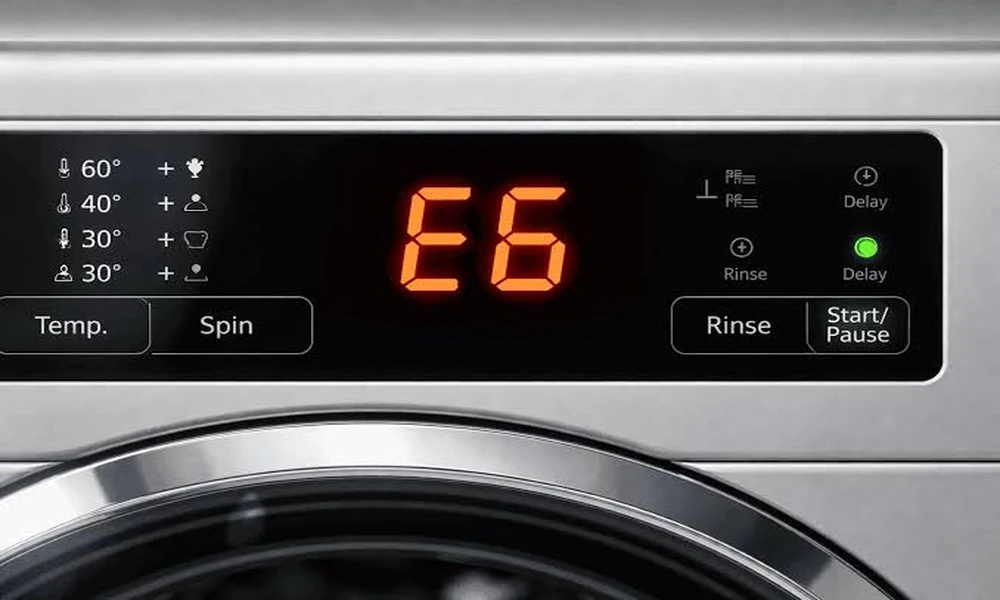
An error code on a washing machine is a diagnostic message, not a verdict. It narrows the fault to a subsystem – water supply, drainage, motor, door, temperature – and a meaningful proportion of the time the cause is something you can resolve in ten minutes with no tools.
This guide explains how to approach a code, the checks worth running for each fault family, and where the line sits between user maintenance and a service call.
Code tables are specific to the maker and the model generation – the Beko washing machine manuals use a different mapping from Samsung or Bosch, so use the one for your machine.
First, get the code and the model right
Codes are grouped into families by the area they relate to, and the same letter prefix generally points to the same subsystem across a model range. The specific meaning, however, varies between generations and between market variants.
Two practical points. Display segments can be ambiguous – a character that looks like one letter on a seven-segment display can be another, which sends people down the wrong path entirely. And the model number, on the door frame or the rear panel, determines which code table applies. Write both down before searching for anything.
Water intake faults
The machine is not filling, or not filling fast enough within its expected window.
Check both taps are fully open. Half-open taps are a common cause after a plumbing job.
Check the inlet hoses are not kinked behind the machine.
Clean the inlet filters. Small mesh screens sit where the hoses attach to the machine and to the tap, and they clog with sediment. This single check resolves a large share of fill faults.
Confirm mains pressure by running a nearby tap.
On machines with hot and cold fills, check both, since a fault can appear only on certain programmes.
Drainage faults
The most common family, and the most likely to be resolvable without an engineer.
Clean the drain pump filter. It is behind a small access panel at the front bottom of the machine and traps coins, hair grips and buttons. Manufacturers expect this to be done periodically and almost nobody does it.
Check the drain hose for kinks and for correct height. A hose sitting too low siphons; too high and the pump cannot lift the water.
Check the standpipe or sink trap connection for a blockage.
Listen during the drain phase. A pump running with no water movement suggests a blockage; silence suggests the pump is not being driven.
Place a shallow tray and towels before opening the filter. There is more water behind it than people expect.
Door and lock faults
Check nothing is trapped in the seal – a sock caught in the door is a genuine and frequent cause.
Push the door firmly closed until it latches audibly.
Wipe the seal and latch area. Detergent residue builds up and prevents proper closure.
After a cycle, the lock releases only once the drum has stopped and any water is drained, which can take a minute or two. Waiting is often the fix.
Unbalanced load faults
The machine has detected the drum cannot spin safely. Causes are usually mechanical and obvious once you look:
A single heavy item such as a towel or duvet on its own. Adding a few smaller items helps the drum balance.
Overloading, which prevents redistribution.
The machine not being level. Check with a spirit level across the top and adjust the feet.
Transit bolts left in place after installation, which is a recurring cause on newly installed machines and produces dramatic noise as well as errors.
Temperature and heating faults
These generally indicate a sensor or heating element issue and sit beyond routine user checks. Before assuming that, confirm the programme selected actually heats, and that a cold-fill-only installation is not being asked to run a hot programme.
The reset that sometimes works
Disconnect the machine at the wall for several minutes, then restore power and run a short cycle. This clears transient faults caused by a momentary supply issue or a sensor glitch. A code that returns immediately after a power cycle is reporting a real condition.
Filter positions and drain hose heights differ between machines too, which is worth confirming in the service and owner’s guides for your exact model.
Preventive maintenance
Clean the drain pump filter every month or two.
Run a maintenance or drum clean cycle regularly, at high temperature and empty.
Leave the door and detergent drawer ajar between washes to let the drum dry.
Remove and clean the detergent drawer periodically.
Avoid over-dosing detergent, which leaves residue that causes odour and sensor problems.
Frequently asked questions
Can I run the machine while a code is showing?
Not advisable. The machine has stopped for a reason, and overriding it risks a leak or further damage.
Why does the code only appear sometimes?
Intermittent codes often reflect load-dependent conditions – a partial drain restriction that only shows on heavy loads, for instance.
Is a code always a fault?
No. Several codes report conditions such as an unbalanced load or an open tap, which are situational rather than mechanical failures.
Note: disconnect the machine from the mains and turn off the water supply before accessing filters or hoses. Code meanings differ between models, so confirm against documentation for your exact model number.
