

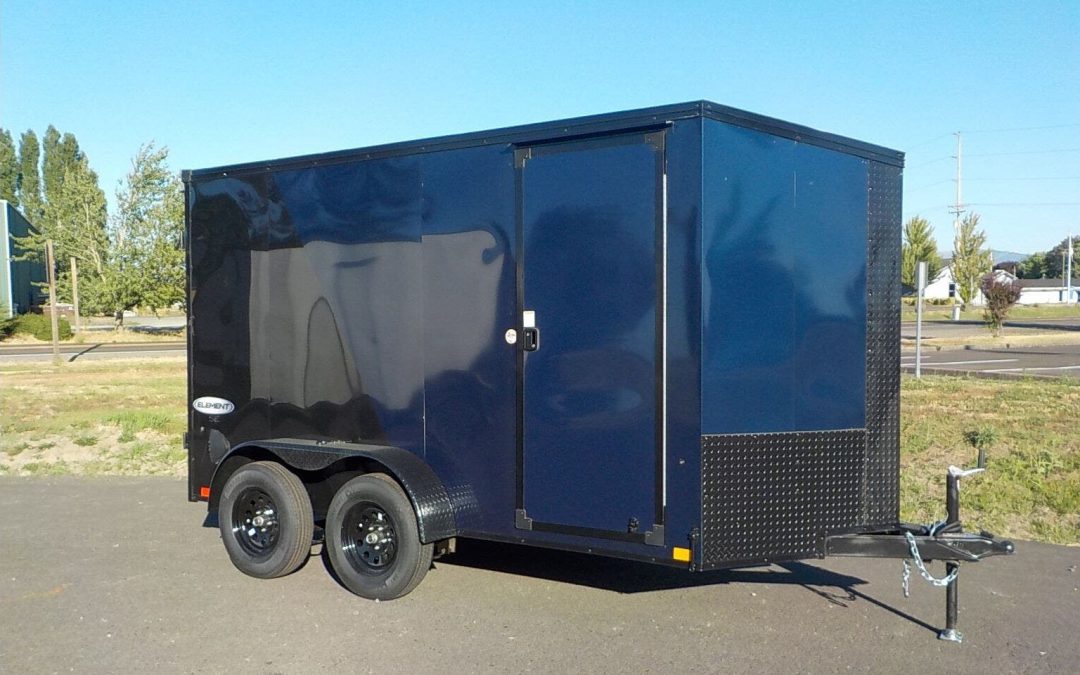
An enclosed cargo trailer is the closest thing a small contractor has to a mobile shop. It locks. It keeps tools and materials dry through Idaho’s unpredictable spring weather. It stays organized between jobs so that Monday morning starts with loading the truck, not spending an hour hunting for the right fitting in a pile of equipment that shifted over the weekend. For contractors across southern Idaho’s trades, from electricians and plumbers working residential jobs in the Magic Valley to general contractors running renovation crews between Twin Falls and Pocatello, the enclosed cargo trailer is the piece of equipment that turns a pickup truck into a fully functional service operation. Grizzly Trailer Sales carries Pace American and American Hauler enclosed trailers at both our Rupert and Montpelier locations, and the sizing conversation we have with contractors follows the same pattern every time: what’s your trade, what do you carry daily, and how do you load it?
Those three questions determine everything.
Size by Trade, Not by Budget
The temptation when buying a first enclosed trailer is to save money on a smaller unit with the assumption that you’ll make it work. Contractors who buy too small end up either leaving essential equipment behind on certain jobs or cramming things in so tightly that loading and unloading adds twenty minutes to each end of the workday. Buying one size up from what you think you need almost always proves to be the right call within the first three months.
The Solo Operator: 6×12 Single-Axle
A 6×12 is the entry point for contractors who work alone or with one helper and carry a manageable tool load. Think handyman services, mobile detailing, small-scale painting operations, and appliance repair. The single-axle configuration keeps the trailer light enough for a half-ton truck, and 72 square feet of floor space holds shelving, a work bench, and the core tools of a single trade without feeling like you’re digging through a storage unit.
A solo electrician running residential service calls can fit wire spools, a bending station, hand tools, panel boards, and a rolling tool chest in a 6×12 with room to move. A mobile detailer can set up a pressure washer, buffer, vacuum, chemical shelves, and water tank without running out of floor space. The key at this size is vertical organization. Shelving on the walls keeps the floor clear for items that need to roll in and out, and the pegboard or slat wall behind the shelving provides accessible storage for hand tools and small parts.
The GVWR on a typical 6×12 single-axle runs around 2,990 lbs, with a payload capacity after the trailer’s own weight of roughly 1,500 lbs. That payload is adequate for tools and supplies but won’t support heavy materials. If you’re regularly hauling lumber, sheet goods, or concrete products in addition to your tools, you’ll exceed the payload capacity quickly and need to step up.
The Full-Service Crew: 7×14 Tandem-Axle
The 7×14 is the workhorse configuration for most trade contractors in southern Idaho. The tandem axle provides stability on the highway, braking on both axles for safe stopping at load, and a GVWR in the 7,000 lb range that gives you a meaningful payload for tools, equipment, and materials combined.
An electrician or plumber running a crew of two to three can fit a full complement of power tools, pipe stock or wire reels, fittings inventory, a compressor, a job box, and still have a clear aisle down the center for loading and access. A framing or remodeling contractor can carry a table saw, miter saw, compressor, nail guns, hand tools, safety equipment, and a reasonable amount of lumber or sheet stock for the current job.
The 7×14 is also the size where interior height starts to matter. Standard interior height on most enclosed trailers is around 6 feet. For contractors who need to stand upright inside the trailer, either to work at a bench or to access shelving above head height, upgrading to a 6’6″ or 7-foot interior height is worth the incremental cost. Spending eight hours a day hunched over in a trailer that’s two inches too short is a problem you feel in your back by Wednesday.
The Large Operation: 8.5×16 and Up
Once you’re running multiple crews, stocking materials for the week rather than the day, or carrying large equipment like scaffolding, generators, or welding rigs, the 8.5×16 and larger sizes become the right fit. These are tandem-axle trailers with GVWRs from 7,000 to 10,000 lbs and payload capacities that can handle both a full tool complement and a meaningful material load.
General contractors who run renovation or remodeling crews through the Mini-Cassia area often land in this range because the trailer serves as both tool storage and materials staging. Rather than making a supply run every morning, the crew loads materials for two or three days of work and operates from the trailer on-site. The time savings on a job that’s 30 miles from the nearest supply house in Burley or Twin Falls adds up quickly over the course of a project.
Features That Earn Their Cost
What Grizzly Trailer Sales Recommends for Working Contractors
Not every upgrade on an enclosed trailer is worth the money for a contractor. Some features pay for themselves within weeks. Others are nice to have but don’t change how the trailer performs as a working tool.
V-nose vs. flat nose. A V-nose front adds two to four feet of enclosed space ahead of the axle line, improves aerodynamics for better fuel economy during highway pulls, and provides a natural area for shelving or a workbench that doesn’t interfere with the main cargo area. For contractors making regular highway trips between job sites across the Magic Valley, the fuel savings alone justify the modest price difference over a flat nose. The V-nose section is also ideal for mounting a small workbench or parts organizer, keeping the main floor clear for larger equipment.
Rear ramp door vs. barn doors. This decision depends entirely on what you load and how you load it. A ramp door lets you roll heavy items in and out: welders, generators, compressors on wheels, rolling tool chests, and appliance dollies. If the heaviest thing you carry rolls, you want a ramp. Barn doors are lighter, don’t require clearance behind the trailer to swing down, and work well for contractors who hand-carry their loads in and out. Some trailers offer a ramp door with a built-in barn door function, giving you both options. For most trade contractors, the ramp door is the more versatile choice.
Side door. A side door, typically a 32-inch or 36-inch entry on the curbside wall, is one of the most underrated features on a cargo trailer. It lets you access frequently needed tools and materials without opening the rear door, which matters when you’re parked on a job site with limited clearance behind the trailer or when you just need to grab one item and get back to work. For contractors who use the trailer as an active workspace throughout the day rather than just a transport container, the side door saves significant time.
D-rings and E-track. D-rings bolted to the floor and walls provide tie-down points for securing loads during transport. E-track, which runs in horizontal or vertical channels along the walls, provides adjustable anchor points for straps and can also serve as mounting for shelving, hooks, and accessories. For contractors who rearrange their trailer layout depending on the job, E-track offers flexibility that fixed D-rings don’t. For contractors whose layout stays consistent, D-rings are simpler and less expensive.
Interior lighting. A trailer without interior lighting is a trailer you can’t use effectively on early winter mornings or when parked in a shadowed area. LED dome lights wired to a switch near the side door provide enough visibility to find what you need and organize for the day. Running LED strip lights along the ceiling ridge gives even, shadow-free illumination across the full interior. The electrical draw is minimal, and the productivity improvement is immediate.
Idaho Conditions That Affect Your Trailer Choice
Southern Idaho’s climate puts specific demands on an enclosed trailer. Summer temperatures in the Magic Valley and Bear Lake areas regularly push into the 90s, and a sealed enclosed trailer sitting in direct sun can reach interior temperatures well above 120 degrees. If you carry temperature-sensitive materials like adhesives, sealants, paints, or certain plumbing and electrical components, ventilation matters. Flow-through vents mounted near the roof ridge and low on the walls create passive air circulation that moderates interior temperature during summer months.
Winter presents the opposite concern. Road salt and magnesium chloride used on Highway 30, Highway 93, and Interstate 84 during winter months are corrosive to trailer frames and undercarriages. A trailer with a powder-coated or painted steel frame handles Idaho winters better than raw or minimally treated steel. Rinsing the undercarriage after winter highway driving extends the life of the frame, suspension components, and wiring connections.
The dust conditions on southern Idaho’s gravel county roads, which connect many rural job sites to the highway network, also affect the trailer. Dust infiltration through gaps around doors, vents, and seams can coat tools and materials with fine particulate after a single trip down a dirt road. Weather stripping around the rear door and side door, and sealed joints along the roof and wall panels, keep the interior significantly cleaner than economy models with looser tolerances.
The Trailer Should Match the Work
An enclosed cargo trailer that fits your trade, your crew size, and your daily workflow becomes the most used piece of equipment you own. One that’s too small, too heavy for your truck, or missing the features that matter for your specific work becomes a frustration that costs you time on every job. Grizzly Trailer Sales carries enclosed cargo trailers from Pace American and American Hauler in sizes from 6×12 through 8.5×20 and larger at our Rupert and Montpelier locations. Bring your truck and a list of what goes inside, and we’ll match you with the size and configuration that works for your trade. The right enclosed trailer doesn’t just carry your tools. It makes your operation faster, more organized, and more professional from the first job you pull it to.
